Skip to content

ROS 2 Topic Reference ​

Complete reference of the ROS 2 topics exposed by the robot's onboard software over CycloneDDS.

There is no separate driver node to run. The core software (Network) speaks ROS 2-compatible DDS directly, so ros2 topic, rviz2, and rqt interoperate with the robot without launching any bridge process. (The legacy rbq_driver node is removed. scripts/start_ros_driver.bash is only a stub left in its place: it prints a deprecation notice every 10 seconds until you stop it.)

  • Pub — robot publishes, your node subscribes
  • Sub — your node publishes, robot subscribes

Custom message types (rbq_msgs/*, api/*) require sourcing the built workspace:

bash
source rbq_sdk/ros2/install/setup.bash

Topics whose name contains a token starting with _ (e.g. /rbq/_sim, /rbq/_user_command, /rbq/ref/motion/_0) are hidden — ros2 topic list shows them only with --include-hidden-topics.

Publish rate — Network republishes every Pub state topic at ~500 Hz while at least one DDS subscriber is connected (with none, nothing is sent), so the Hz below is that publish rate (measured with ros2 topic hz), not the underlying sensor/value update rate.

Zenoh — A subset of these topics also exists on Zenoh with the same names and messages, so ROS 2 nodes on rmw_zenoh see it too: /rbq/odometry (500 Hz), /rbq/robot_status and /rbq/battery (50 Hz), /rbq/led_bottom (1 Hz), and the commands /rbq/cmd/high_level, /rbq/cmd/switch_gait, /rbq/cmd/switch_control_mode, /rbq/cmd/dock, /rbq/cmd/auto_start, /rbq/cmd/led_bottom and /rbq/cmd/ptz. Everything else is DDS only.

Motion Commands ​

/rbq/cmd/auto_start ​

FieldValue
Typestd_msgs/Bool
DirectionSub
DescriptionFull initialization sequence: CAN check → Find Home → Control Start. Robot must be in the correct initial pose. Monitor progress via /rbq/robot_status (can_check, find_home, con_start flags).

/rbq/cmd/switch_gait ​

FieldValue
Typestd_msgs/Int8
DirectionSub
DescriptionSwitch to the target gait by gait_id. See Gait State Reference below.

/rbq/cmd/switch_control_mode ​

FieldValue
Typestd_msgs/Bool
DirectionSub
Descriptiontrue → HighLevel Command mode (accepts /rbq/cmd/high_level). false → Joystick mode (default). While false, high-level commands are ignored without any error.

/rbq/cmd/emergency ​

FieldValue
Typestd_msgs/Bool
DirectionSub
DescriptionImmediately set all joints to high-damping mode. Robot collapses instantly. Sit the robot down first if testing.

/rbq/cmd/dock ​

FieldValue
Typestd_msgs/Int8MultiArray
DirectionSub
DescriptionStart the auto-docking sequence. data[0]: walk mode — 0 = wave (default), 1 = trot. data[1]: vision mode — 0 = blind (default), 1 = vision height feedback (trot only). Robot must be in Standing mode and the front or rear camera must see the ArUco marker (within 3 m recommended; the firmware aborts beyond 5 m). Monitor via robot_status.docking_state.

/rbq/ref/payload_params ​

FieldValue
Typestd_msgs/Float64MultiArray
DirectionSub
DescriptionSet external payload parameters for CoM compensation. data: [mass_kg, com_x, com_y, com_z] (meters). Used when carrying additional loads. This is a separate slot from the payload.* parameters of /rbq/motion/set_param, so get_param does not read these values back.

/rbq/ref/payload_slot ​

FieldValue
Typestd_msgs/Float64MultiArray
DirectionSub
DescriptionSet one payload slot. data: [slot, mass_kg, com_x, com_y, com_z] (meters). Same checks as PUT /api/payload/parameters; other slots are left as they are.

/rbq/option/status ​

FieldValue
Typestd_msgs/String
DirectionSub
DescriptionStatus from the installed option's program, as JSON: {"items":[{"key","label","value","unit","level"}]} (level ok, warn or error; up to 64 items). The app reads it through GET /api/option/status. An error item received within 5 s lights the comm-lost lamp.

/rbq/option/command ​

FieldValue
Typestd_msgs/String
DirectionPub
DescriptionCommands to the installed option's program, as JSON {"key","value"}, sent by POST /api/option/command.

Gait State Reference ​

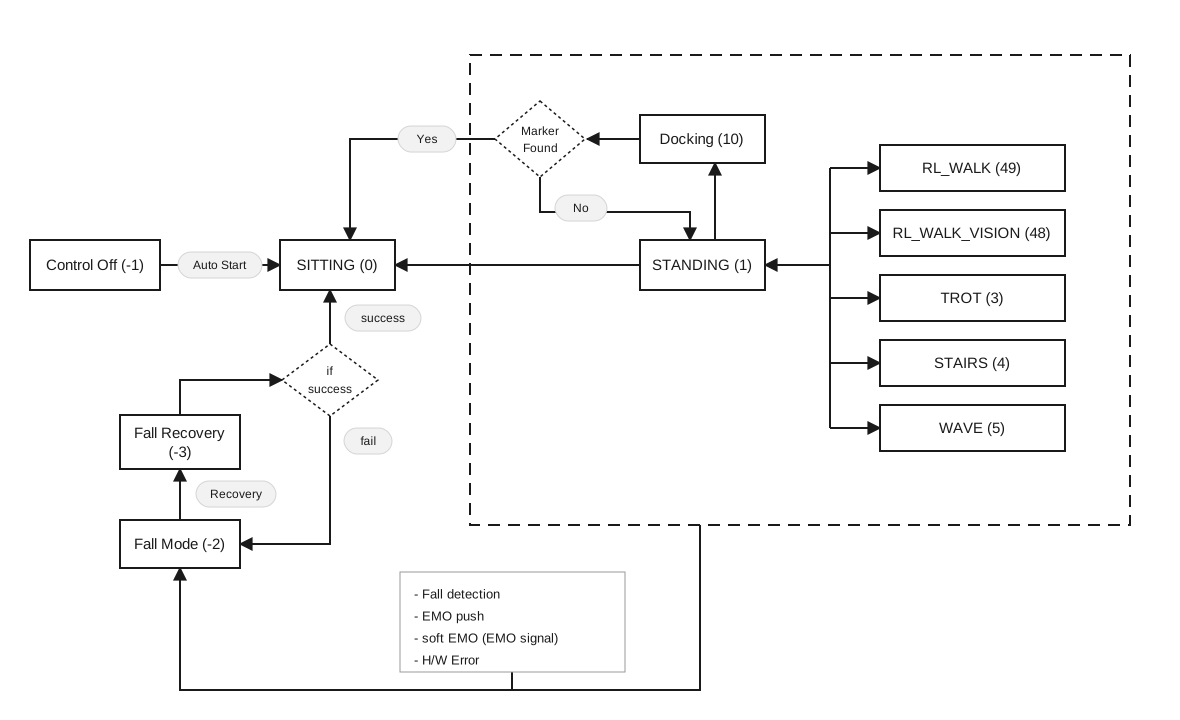
One gait enum is used in both directions: send it on HighLevelCommand.gait_state (also used by switch_gait), and read the same value back on robot_status.gait_id.

gait_idNameDescription
-3Fall RecoveryAutomatic recovery attempt after a fall
-2Fall ModeTriggered by unexpected loss of balance
-1Control OffAll actuators disabled
0SittingLow posture, resting on ground
1StandingNeutral posture, ready to walk
3Walk (Trot)Walking trot gait
4StairsStair-adaptive gait (uses camera)
5WaveWalking wave gait
10DockingAuto-docking sequence
48RL Walk (Vision)Learned walking gait with vision-based terrain adaptation
49RL WalkLearned walking gait

-3, -2 and -1 are status only — switch_gait and HighLevelCommand ignore them. 10 starts docking (wave, blind) on switch_gait only — HighLevelCommand ignores it. /rbq/cmd/dock lets you pick the walk and vision mode.

Setting an RL gait

Use STATE_RL_WALK_VISION (48) or STATE_RL_WALK (49). The other STATE_RL_* constants (30–47) are deprecated and not supported.

Gait state transition diagram

High-Level Control ​

/rbq/cmd/high_level ​

FieldValue
Typerbq_msgs/HighLevelCommand
DirectionSub
DescriptionVelocity and posture command. Behavior and valid ranges depend on the current gait. Requires HighLevel mode (switch_control_mode: true). If the last command is older than 1 second, vel_x / vel_y / omega_z are treated as 0 (posture and height keep their last values).

Fields:

FieldTypeUnitDescription
headerstd_msgs/Header—ROS header with timestamp
identifierstring—Optional label for logging/tracking
rollfloat32degBody roll. Standing [-25, +25]
pitchfloat32degBody pitch. Standing [-20, +20], Walk (body tilt angle), RL Walk [-25, +25]
yawfloat32degBody yaw twist. Standing [-25, +25]
vel_xfloat32m/sForward speed. Walk [-1.0, +1.2] / RL Walk [-1.5, +2.5] / Stairs [-1.0, +1.0]
vel_yfloat32m/sLateral speed. Walk [-0.4, +0.4] / RL Walk [-1.0, +1.0] / Stairs [-0.4, +0.4]
omega_zfloat32deg/sYaw rate. Walk [-75, +75] / Stairs [-17, +17] / Wave [-20, +20] / RL Walk [-86, +86]
delta_body_hfloat32mBody height offset from default. Standing/Walk [-0.15, +0.05] / RL Walk [-0.25, +0.10]
delta_foot_hfloat32mSwing foot lift offset. [-0.06, +0.04]
gait_stateint8—Target gait ID (see Gait State Reference)
gait_transitionbool—true = transition to gait_state first, then apply command

Example commands:

bash
# Walk forward at 0.5 m/s (gait_state: 3 = Walk/Trot)
ros2 topic pub --once /rbq/cmd/high_level rbq_msgs/msg/HighLevelCommand \
'{header: {stamp: {sec: 0, nanosec: 0}, frame_id: "base"},
  identifier: "walk_fwd", roll: 0.0, pitch: 0.0, yaw: 0.0,
  vel_x: 0.5, vel_y: 0.0, omega_z: 0.0,
  delta_body_h: 0.0, delta_foot_h: 0.0,
  gait_state: 3, gait_transition: false}'

# Rotate in place at 30°/s
ros2 topic pub --once /rbq/cmd/high_level rbq_msgs/msg/HighLevelCommand \
'{header: {stamp: {sec: 0, nanosec: 0}, frame_id: "base"},
  identifier: "turn", roll: 0.0, pitch: 0.0, yaw: 0.0,
  vel_x: 0.0, vel_y: 0.0, omega_z: 30.0,
  delta_body_h: 0.0, delta_foot_h: 0.0,
  gait_state: 3, gait_transition: false}'

# Stop (zero velocity)
ros2 topic pub --once /rbq/cmd/high_level rbq_msgs/msg/HighLevelCommand \
'{header: {stamp: {sec: 0, nanosec: 0}, frame_id: "base"},
  identifier: "stop", roll: 0.0, pitch: 0.0, yaw: 0.0,
  vel_x: 0.0, vel_y: 0.0, omega_z: 0.0,
  delta_body_h: 0.0, delta_foot_h: 0.0,
  gait_state: 3, gait_transition: false}'

# Custom standing posture (roll: 15°, pitch: 30°, yaw: 20°)
ros2 topic pub --once /rbq/cmd/high_level rbq_msgs/msg/HighLevelCommand \
'{header: {stamp: {sec: 0, nanosec: 0}, frame_id: "base"},
  identifier: "standing_pose", roll: 15.0, pitch: 30.0, yaw: 20.0,
  vel_x: 0.0, vel_y: 0.0, omega_z: 0.0,
  delta_body_h: 0.0, delta_foot_h: 0.0,
  gait_state: 1, gait_transition: true}'

Continuous walking needs periodic publishing

As a safety measure, velocities are zeroed once the last command is older than 1 second — so a velocity command sent with --once stops the robot within a second. To keep it walking, publish periodically, e.g. ros2 topic pub -r 50 … (stop with Ctrl+C). Also note that when gait_transition: true and the current gait differs from gait_state, that message only performs the gait transition and its velocities are ignored — switch the gait first, then stream velocities.

/rbq/cmd/navigate_to ​

FieldValue
Typegeometry_msgs/Pose2D
DirectionSub
DescriptionMove to a pose relative to the robot, measured from where it stands when the command arrives: x forward and y left in meters, theta the heading change in radians. Available in Standing and Wave modes.

/rbq/cmd/target_go ​

FieldValue
Typerbq_msgs/TargetGo
DirectionSub
DescriptionRelative "go to target" navigation command (gait, mode, x/y/theta, offsets, and slow/wide/vision flags). See the Target-Go example.

Robot Status ​

/rbq/robot_status ​

FieldValue
Typerbq_msgs/RobotStatus
DirectionPub
Hz500
DescriptionOverall robot status flags, gait state, and docking progress.

Fields:

FieldTypeDescription
headerstd_msgs/HeaderROS header
con_startboolMotor control enabled
ready_posboolRobot is in ready position
ground_posboolRobot is in ground/sitting position
force_conboolForce control mode active
ext_joyboolExternal joystick connected
is_standingboolRobot is physically standing
can_checkboolCAN communication verified
find_homeboolEncoder homing complete
gait_idint8Current gait. See Gait State Reference.
is_fallboolFall detected
docking_stateint8Docking progress (see table below)
imu_successboolIMU connected and operational

Docking State Values:

ValueConstantDescription
-5DOCKING_ABORTEDCancelled by user or external command — aborted
-4DOCKING_MAX_FAIL_CNT_REACHEDMax retry count (10×) reached — aborted
-3DOCKING_MARKER_POS_INVALID_TOO_FARMarker > 5 m — aborted
-2DOCKING_MARKER_NOT_FOUNDMarker not found — aborted
-1DOCKING_FAILEDDocking failed — auto retry
0DOCKING_OPERATION_MODENormal operation (not docking)
1DOCKING_APPROACH_OFFSETStage 1: offset approach
2DOCKING_APPROACHStage 2: direct approach
3DOCKING_APPROACH_WIDEStage 3: wide-stance approach
4DOCKING_SIT_DOWNSitting down to connect
5DOCKING_SUCCESSDocked — charger physically connected
6DOCKING_SUCCESS_CHARGINGDocked and charging
7DOCKING_SUCCESS_NO_CHARGINGDocked but not charging

/rbq/system_log ​

FieldValue
Typerbq_msgs/SystemLog
DirectionPub
DescriptionRobot-side log stream. Fields: header, string log_level, string log_msg.

Heartbeat ​

Once a second, three diagnostic_msgs/DiagnosticArray topics report whether each part of the robot is alive — for monitoring tools that do not need the 500 Hz state topics. Each one publishes only while a subscriber is attached. level is 0 OK, 1 WARN, 2 ERROR, and values holds string key/value pairs.

/rbq/motion/heartbeat ​

FieldValue
Typediagnostic_msgs/DiagnosticArray
DirectionPub
Hz1
DescriptionPublished by Network. One status, motion: level 1 and message fall detected while the robot is down, otherwise 0 and ok. values repeat flags of /rbq/robot_status as 0/1 strings: gait, gait_name, control_mode (= ext_joy), con_start, ready_pos, is_standing, is_fall, can_check, find_home, imu_success, docking_state.

/rbq/vision/heartbeat ​

FieldValue
Typediagnostic_msgs/DiagnosticArray
DirectionPub
Hz1
DescriptionPublished by Streamer on the vision PC. One status, vision.programs, with one value per vision program — handler, hal, streamer, handeye, heightmap, slamnav, cctv, ptz, thermal, human_following, obstacleavoid — each running, idle (process up, work thread not running) or stopped. level 2 and message vision ipc unavailable when the program table cannot be read.

/rbq/sensor/heartbeat ​

FieldValue
Typediagnostic_msgs/DiagnosticArray
DirectionPub
Hz1
DescriptionPublished by HAL on the vision PC. One status per sensor slot that is enabled or running, named sensor_{N}. level 2 (message failed) when the sensor failed, 1 when it is enabled but not detected, otherwise 0.

Values:

KeyDescription
nameSensor name
typeusbcam, realsense, oak, lidar, lan or unknown
enabled, detected, run1 or 0
fps_rgb, fps_ir, fps_depthFrame rate per stream (cameras only)
day, projector_on1 or 0 (cameras only)
fps_pointcloudPoint-cloud rate (lidar only)

State Estimation ​

/rbq/odometry ​

FieldValue
Typenav_msgs/Odometry
DirectionPub
Hz500
DescriptionBody pose and velocity in the world frame. Origin resets at startup. Fused from IMU and leg odometry.

/rbq/foot_states ​

FieldValue
Typerbq_msgs/FootStates
DirectionPub
Hz500
DescriptionFoot positions, velocities, and contact states for all 4 legs relative to the body center frame.

Fields:

FieldTypeDescription
headerstd_msgs/HeaderROS header
foot_position_rt_bodygeometry_msgs/Point[4]Foot position relative to body center. +X=forward, +Y=left, +Z=up
foot_velocity_rt_bodygeometry_msgs/Point[4]Foot velocity relative to body frame
foot_contact_estuint8[4]Contact state per foot: 0 = CONTACT_LOST, 1 = CONTACT_MADE
foot_force_estfloat32[4]Estimated contact force [N]

Leg order: [0] = Rear-Right, [1] = Rear-Left, [2] = Front-Right, [3] = Front-Left — the same HR, HL, FR, FL order as the joints

Sensor Feedback ​

/rbq/imu ​

FieldValue
Typesensor_msgs/Imu
DirectionPub
Hz500
DescriptionRaw IMU data. Sensor offset from body center: (0.00665, 0.0, -0.0404) m. Frame: +X = forward, +Y = left, +Z = up. Angular velocity range ±2000 °/s, acceleration range ±16 g.

/rbq/joint_states ​

FieldValue
Typesensor_msgs/JointState
DirectionPub
Hz500
DescriptionJoint names and positions [rad] for all 12 leg joints in standard ROS format. velocity and effort are left empty — read them from /rbq/leg_joint.

/rbq/leg_joint ​

FieldValue
Typerbq_msgs/LegJointInfo
DirectionPub
Hz500
DescriptionDetailed per-joint status for all 12 leg joints. LegJointInfo wraps JointInfo[12] joint — one JointInfo per joint (there is no JointStatus message).

Joint order (conventional): [0]HRR [1]HRP [2]HRK [3]HLR [4]HLP [5]HLK [6]FRR [7]FRP [8]FRK [9]FLR [10]FLP [11]FLK — but each joint[i] carries its own 3-letter name, which is the authoritative identifier.

JointInfo fields (each element of joint[12]):

FieldTypeUnitDescription
posfloat32radMeasured position
velfloat32rad/sAngular velocity
accfloat32rad/s²Always 0 — not filled
torquefloat32N·mMeasured torque
kpfloat32Nm/radPosition gain
kdfloat32Nm·s/radDamping gain
ownerint8—Process owning the joint (0–40)
ref_ff_torquefloat32N·mReference feed-forward torque
ref_positionfloat32radReference (target) position
ref_velfloat32rad/sReference velocity — 0 on a classic CAN robot (CAN FD only)
currentfloat32AMotor current
temperature_boardint8°CControl board temperature
temperature_coilint8°CMotor coil temperature
namestring≤3—3-letter joint name, e.g. "HRR"
statusstring≤3—3-letter lifecycle: NON/CON/HOM/RUN
error_msgstring≤3—3-letter error code, e.g. "JAM", "OK"

Reference limits: torque ±TORQUE_LIMIT_Nm of the platform profile (rbq10: Roll/Pitch 100 Nm, Knee 150 Nm, Wheel 30 Nm; the knee's folding direction is bounded by T_LIM_K_L, −70 Nm); ref_vel ±VELOCITY_LIMIT_rad_s of the platform profile (rbq10: Roll/Pitch 44 rad/s, Knee 33 rad/s, Wheel 144 rad/s); pos within the physical joint limit widened on each side by TORQUE_LIMIT_Nm / kp (not clamped while kp is 0; wheels have no position limit). A reference beyond its limit is clamped, not rejected. A NaN or Inf in any field of a joint holds that joint: pos, kp and kd keep their previous values, torque and ref_vel become 0, and a warning is logged.

Power Control ​

/rbq/cmd/switch_power ​

FieldValue
Typestd_msgs/Int8MultiArray
DirectionSub
DescriptionToggle a PDU power port. data: [port_id, state] — state: 1=ON, 0=OFF. While a board firmware update is running, turning port 0 or 1 on is ignored.

Port ID Reference:

port_idPort
0 (0x00)48 V — Leg actuators
1 (0x01)48 V — Add-on device (top)
2 (0x02)48 V — External port (top)
16 (0x10)12 V — Vision PC (internal)
17 (0x11)12 V — LAN comm port (top)
18 (0x12)12 V — LiDAR port (top)
19 (0x13)12 V — CCTV port (top)
20 (0x14)12 V — Thermal cam port (top)
21 (0x15)12 V — IR LED (front/rear panel)
22 (0x16)12 V — Speaker amplifier
32 (0x20)5 V — Camera USB hub
33 (0x21)5 V — Audio / side-cam USB hub
cpp
// PDU port ID enum (used as data[0] in switch_power)
enum PDU_PORT_IDs_e : unsigned char {
    PDU_PORT_48V_LEG                   = 0x00,  // Leg actuators
    PDU_PORT_48V_ADD                   = 0x01,  // Add-on device
    PDU_PORT_48V_EXT                   = 0x02,  // External port
    PDU_PORT_12V_VisionPC              = 0x10,  // Vision PC
    PDU_PORT_12V_COMM                  = 0x11,  // LAN comm port
    PDU_PORT_12V_Lidar                 = 0x12,  // LiDAR port
    PDU_PORT_12V_CCTV                  = 0x13,  // CCTV port
    PDU_PORT_12V_THER                  = 0x14,  // Thermal camera
    PDU_PORT_12V_IRLed                 = 0x15,  // IR LED
    PDU_PORT_12V_Speaker               = 0x16,  // Speaker amplifier
    PDU_PORT_5V_CAMERAS                = 0x20,  // Camera USB hub
    PDU_PORT_5V_AUDIO_SIDE_CAM_USBHUB  = 0x21,  // Audio/side-cam USB hub
};

Example: turn on 12V LiDAR port (PDU_PORT_12V_Lidar = 0x12 → decimal 18)

bash
ros2 topic pub --once /rbq/cmd/switch_power std_msgs/msg/Int8MultiArray "{data: [18, 1]}"

/rbq/battery ​

FieldValue
Typerbq_msgs/BatteryState
DirectionPub
Hz500
DescriptionBattery status for the dual battery pack. Every field is a 2-element array ([0] = pack 0, [1] = pack 1).

Fields:

FieldTypeDescription
headerstd_msgs/HeaderROS header
identifieruint32[2]Per-pack identifier
statusuint8[2]Not per pack: [0] = manual charger, [1] = charging station — 2 (Charging) while that charger is connected, otherwise 3 (Discharging). 0 (Unknown) and 1 (Missing) are not sent
charge_percentageuint8[2]State of charge [0, 100] %
temperatureint8[2]Pack temperature [°C]
currentfloat32[2]Load current [A]
voltagefloat32[2]Pack voltage [V]

Bottom LED ​

The two status LEDs under the body, one on each side. CAN FD robots only — on other robots the command is rejected and no state is published. The simulator counts as one: Motion stands in for the IF board and MuJoCo shows the two LEDs under the body. The same setting is reachable over REST as GET / PUT /api/led/bottom.

/rbq/cmd/led_bottom ​

FieldValue
Typerbq_msgs/LedBottom
DirectionSub
DescriptionSet one or both bottom LEDs. side: 1=right 2=left 3=both (the other LED keeps its setting). mode: 0=off 1=on 2=blink. rgb: uint8[3]. on_ms / off_ms: blink on / off time 10–2550 ms (10 ms steps). count: blink repeats, 0=forever. Out-of-range values are rejected (logged by Network on the robot). See the Bottom LED example.

Example: both LEDs blinking red, 0.5 s on / 0.5 s off, forever

bash
ros2 topic pub --once /rbq/cmd/led_bottom rbq_msgs/msg/LedBottom "{side: 3, mode: 2, rgb: [255, 0, 0], on_ms: 500, off_ms: 500, count: 0}"

/rbq/led_bottom ​

FieldValue
Typerbq_msgs/LedBottomState
DirectionPub
Hz1
DescriptionWhat the IF board last reported — the setting it holds, the output after the power limit, and its firmware version.

Fields:

FieldTypeDescription
age_msint32ms since the last report, -1 = none yet
configuredboolfalse = the IF board rebooted and holds no setting (Motion resends the last one)
if_fwuint32IF firmware version (yyyymmddnn), 0 = unknown
right, leftLedBottomSideper-LED state, below

rbq_msgs/LedBottomSide:

FieldTypeDescription
modeuint80=off 1=on 2=blink
rgbuint8[3]set colour
on_ms, off_msuint16blink times [ms], 0 unless blinking
countuint8blink repeats, 0=forever, 0 unless blinking
actualuint8[3]last output after the power limit, 0 when off
limitedboolthe power limit reduced the output within the last second
legacyboolset through the old command — the setting shown is approximate
lpf_wfloat32filtered LED power [W]

Vision — Camera Sensors ​

All camera topics are published by the robot (Pub). Sensors are identified by numeric id — sensor_0–sensor_5 (the old name-based sensor_bottom_N / sensor_front / sensor_rear topics are gone). Each stream has /compressed, /camera_info, and a per-stream /tf (geometry_msgs/PoseStamped).

Sensor idLocationStreams
sensor_0–sensor_3Bottom/body depth sensorsdepth, ir
sensor_4Front RGB-Ddepth, rgb
sensor_5Rear RGB-D (also ArUco docking)depth, rgb

Topic pattern: /rbq/vision/sensor_{N}/{stream}/{sub}

TopicTypeDescription
/rbq/vision/sensor_{N}/{stream}/compressedsensor_msgs/CompressedImageCompressed frame (depth = PNG, ir/rgb = JPEG)
/rbq/vision/sensor_{N}/{stream}/camera_infosensor_msgs/CameraInfoIntrinsics + distortion
/rbq/vision/sensor_{N}/{stream}/tfgeometry_msgs/PoseStampedSensor pose relative to the body

{stream} is depth/ir for sensor_0–sensor_3, and depth/rgb for sensor_4/sensor_5.

Camera threads publish only while a subscriber is attached (hasSubscribers gate) — subscribe first, then read.

Vision — LiDAR ​

Robots with LiDAR (Livox) publish each unit's scan and its built-in IMU. HAL publishes them on the robot; the simulator publishes the same topics when started with --payload livox. Like the cameras, a topic is sent only while a subscriber is attached.

TopicTypeDescription
/rbq/lidar/lidar_frontsensor_msgs/PointCloud2Front LiDAR scan
/rbq/lidar/lidar_front/imusensor_msgs/ImuFront LiDAR's built-in IMU, at the sensor's own rate
/rbq/lidar/lidar_rearsensor_msgs/PointCloud2Rear LiDAR scan
/rbq/lidar/lidar_rear/imusensor_msgs/ImuRear LiDAR's built-in IMU, at the sensor's own rate
  • On the robot, each scan covers 0.1 s (about 10 Hz).
  • Points and IMU are in the raw sensor frame (frame_id lidar_front or lidar_rear) — apply the sensor-to-body transform yourself. IMU acceleration is in m/s².
  • Point fields (point_step 28): x, y, z, intensity, time (float32; time = seconds from header.stamp) and timestamp (float64, absolute seconds).

GPS ​

Available only when a GNSS receiver is installed and enabled in the HAL configuration (configs/HAL/config.ini: [GPS] ENABLED=true, receiver address in [GPS] ADDR and PORT). HAL forwards the receiver's sentences as they arrive, without parsing them.

TopicTypeDescription
/rbq/gps/nmeanmea_msgs/SentenceRaw NMEA GGA, RMC and GST sentences, frame_id gps
/rbq/gps/insstd_msgs/StringRaw DRPVAA sentence from the receiver's INS

nmea_msgs is not part of a base ROS 2 install — install ros-<distro>-nmea-msgs to echo /rbq/gps/nmea.

Vision — PTZ Camera ​

Available only when the optional PTZ camera payload is installed and the Ptz app is running. These topics publish at 20 Hz rather than the 500 Hz of the motion state topics.

Camera-direct control (SUNAPI · RTSP · ONVIF) — presets, focus, audio, and third-party VMS — is documented in PTZ Camera API.

Both carry std_msgs/Float64MultiArray with the same layout and units, so a client reads back what it sends.

IndexFieldUnitRange
data[0]panrad[-175°, +175°]
data[1]tiltrad[-90°, +23°] — asymmetric, only 23° upward
data[2]zoom×[1, 32]

/rbq/ptz ​

FieldValue
Typestd_msgs/Float64MultiArray
DirectionPub
Hz20
DescriptionMeasured pan/tilt angle and camera zoom. data[2] == 0 means the payload has no CCTV camera configured, so there is no zoom to report. The zoom reading refreshes more slowly than pan/tilt and can lag it by a few hundred milliseconds.

/rbq/cmd/ptz ​

FieldValue
Typestd_msgs/Float64MultiArray
DirectionSub
DescriptionAbsolute pan/tilt/zoom setpoint. Values outside the ranges above are clamped by the firmware. The message is ignored unless data holds exactly 3 finite values. A setpoint is latched — send once and the camera holds that pose.

All three values are applied together. Sending [new_pan, 0, 0] to change pan alone also drives tilt to 0 and resets zoom. Read /rbq/ptz first and echo back the fields you do not want to change.

While a PTZ check runs, /rbq/cmd/ptz is ignored, on DDS and on Zenoh alike — the check has the PTZ to itself until it ends.

Examples:

bash
# Read current state
ros2 topic echo --once /rbq/ptz

# Look 20° left, 10° down, 4x zoom  (0.349 rad, -0.175 rad)
ros2 topic pub --once /rbq/cmd/ptz std_msgs/msg/Float64MultiArray "{data: [0.349, -0.175, 4.0]}"

# Return to center at 1x
ros2 topic pub --once /rbq/cmd/ptz std_msgs/msg/Float64MultiArray "{data: [0.0, 0.0, 1.0]}"

TF ​

/tf ​

FieldValue
Typetf2_msgs/TFMessage
DirectionPub
Hz50
DescriptionOnly local_world → base_link — the same pose as /rbq/odometry. There are no leg or sensor frames on /tf; each camera stream carries its pose on its own …/tf topic (see Vision — Camera Sensors). In the simulator, MuJoCo also broadcasts base_link → <lidar> at 2 Hz.

/tf_static (URDF fixed transforms) is published by the rbq_description robot_state_publisher, i.e. only when you run ros2 launch rbq_description description.launch.py — it is not emitted by the robot's core software.

/rbq/joy ​

FieldValue
Typesensor_msgs/Joy
DirectionPub
DescriptionThe robot's current joystick input state (passthrough). Axes [0–5]: left-X, left-Y, right-X, right-Y, L2, R2. Buttons [0–14]. While Send all buttons (developer mode) is off in the app, L2 and R2 stay at 0 and only L1 and R1 come through, in slots [8] and [10]. Published when a frame arrives; when the joystick link drops (no frame for 0.5 s) one all-zero message follows, so the last value never stays.

Topic Subscription Examples ​

bash
# Robot status (500 Hz)
ros2 topic echo --once /rbq/robot_status

# Per-joint leg status (500 Hz)
ros2 topic echo --once /rbq/leg_joint

# IMU data (500 Hz)
ros2 topic echo --once /rbq/imu

# Battery state (500 Hz)
ros2 topic echo --once /rbq/battery

# Foot contact states (500 Hz)
ros2 topic echo --once /rbq/foot_states

# Odometry (500 Hz)
ros2 topic echo --once /rbq/odometry

# Motion heartbeat (1 Hz)
ros2 topic echo --once /rbq/motion/heartbeat

This user manual is intended for RBQ users.