Skip to content

Audio (walkie-talkie) ​

The robot carries a speaker and a microphone. The Audio tool on the control home turns the app into a walkie-talkie: listen to what the robot hears, and hold a button to talk through its speaker.

Opening the popover ​

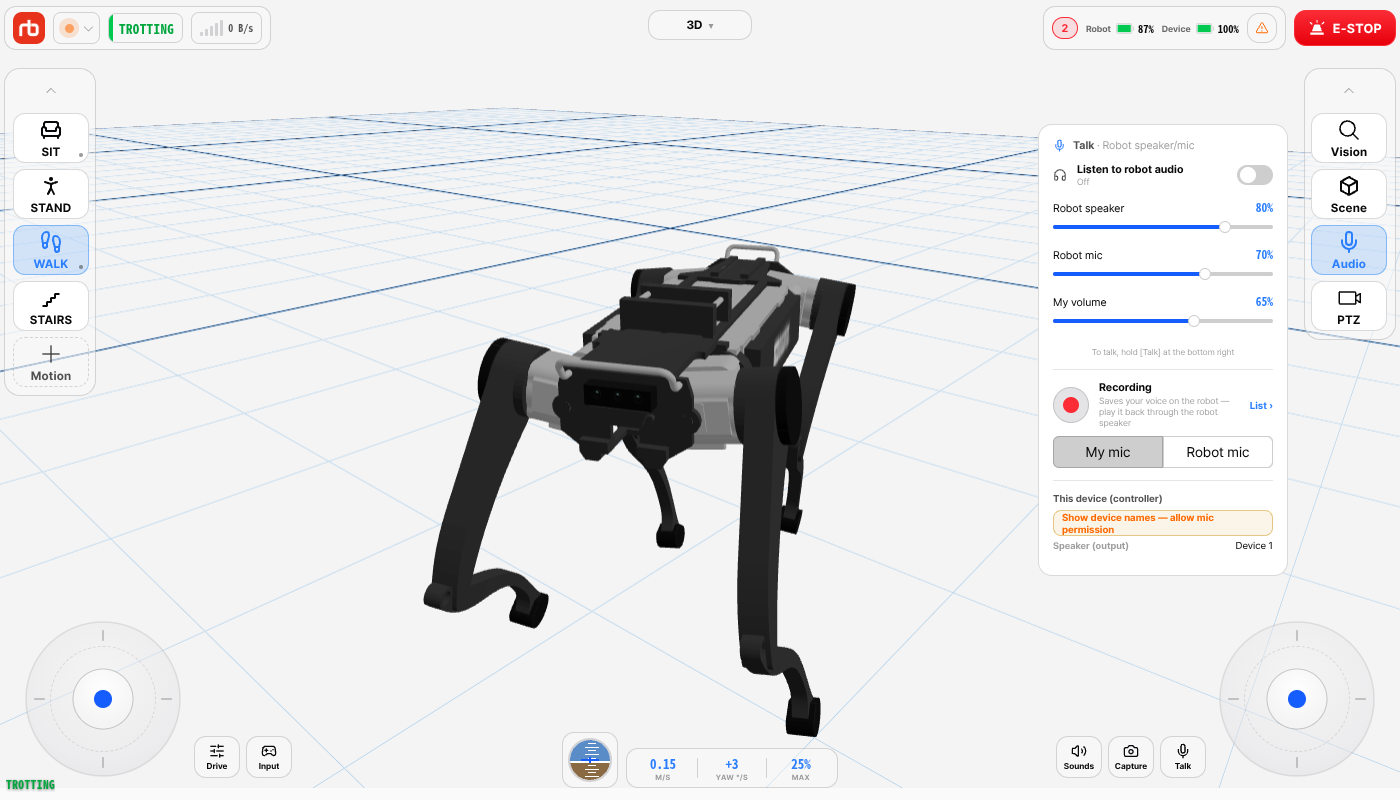
Tap Audio (the microphone icon) in the right card (OBSERVE). The popover is titled Talk · Robot speaker/mic. A green dot on the Audio button means listening is currently on.

Talk popover

Listening ​

Listen to robot audio is a toggle. Switch it on and the robot's microphone streams to your device until you switch it off. The label under it reads Listening or Off. Listening stays on when you close the popover — the dot on the Audio button reminds you.

If the robot has no microphone, the label reads The robot has no microphone and the toggle cannot be switched on. A robot that has a PTZ camera but no microphone of its own listens through the PTZ camera's microphone; the label then reads Listening · PTZ microphone.

Volume ​

Three sliders, each showing its value in percent (defaults 80 / 70 / 65 %):

SliderControls
Robot speakerLoudness of your voice out of the robot.
Robot micGain of the robot's microphone (what you hear when listening).
My volumePlayback level on your own device.

The app stores the last values you set and restores them on the next start.

Push to talk ​

Talking is not in the popover. Press and hold the Talk button at the bottom right of the control home — next to the right joystick, or at the right edge when a gamepad is connected. While you hold it the button turns green and reads Talking. Release it to stop. The app sends your voice only while you hold the button, so nothing goes out by accident — the popover's footer reminds you: To talk, hold [Talk] at the bottom right.

The first time you press the button the app asks for microphone permission. If you refuse (or no microphone can be opened), the Talk button turns amber and the popover's footer changes to No mic permission — allow it in app settings. Grant it in the operating system's app settings and try again.

Recording ​

In the popover's Recording block, tap the red button to start recording and tap it again to stop. Before you start, choose My mic (what you say into Talk while recording) or Robot mic (what the robot's microphone hears). Recordings are stored on the robot; tap List to see them on the media screen and play them through the robot's speaker. See Media for details.

Where the sound goes ​

There is one output, chosen automatically. When a PTZ camera is attached, your voice and every sound played from Media come out of the PTZ camera's speaker instead of the robot speaker, and the popover shows Sound goes out through the PTZ speaker. Without a PTZ camera the robot speaker is used. If the robot has no speaker, the popover shows The robot has no speaker, so talking makes no sound.

Robot speaker power ​

If the robot's speaker amplifier is switched off you will see Robot speaker power is off in the popover, and the Talk button is dimmed and cannot be pressed. Tap Turn on in that banner to power the amplifier and talk again. The banner does not appear while sound goes to the PTZ speaker, which has its own amplifier.

Platform notes ​

  • Audio channel — Robot audio channel failed — check the robot connection in the footer means the audio link to the robot could not be set up. Check that the robot is connected (video is streaming) and press Talk again.
  • This device's speaker and microphone — the This device (controller) block at the bottom of the popover is about the device you are running the app on, not the robot. It appears in a web browser and in the desktop app (including the Steam Deck). With one device connected, Microphone and Speaker (output) just show its name; with two or more, pick one from the drop-down. The speaker row needs a browser that supports output switching — Chrome does, some others do not. If devices show only numbers (Device 1, Device 2…), tap Show device names — allow mic permission. The Android and iOS apps use whatever audio devices the system is on, so this block is hidden there.
  • My mic Send gain — shown only where a microphone volume constraint is still supported. Current Chrome does not, so most browsers hide it; the desktop app (including the Steam Deck) shows it.

This user manual is intended for RBQ users.